



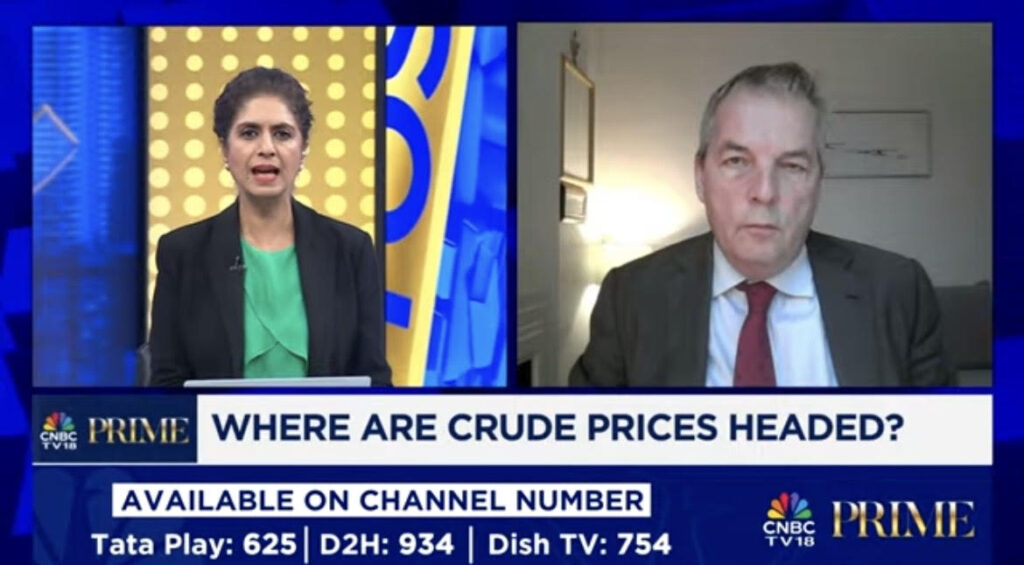
In an interview on CNBC TV18’s The Big C with Manisha Gupta, Christof Rühl, Global Advisor at Crystol Energy, discussed the impact on crude prices as Iran targets tankers in the Strait of Hormuz and tensions in West Asia continue to escalate. He explained why the market reaction so far reflects rising uncertainty more than outright supply loss, while noting that storage, alternative export routes, and relatively comfortable global supply conditions are still helping cushion the shock.
Key takeaways:
The market impact is showing first through higher prices and greater uncertainty, while actual production across most Gulf producers is still continuing.
The central challenge is how to guarantee safe passage through the Strait of Hormuz while conflict and instability persist.
Saudi Arabia and the UAE have alternative pipeline routes that can ease pressure, but redirecting crude will take time and still carries risk.
Storage across Gulf producers can temporarily absorb production, but it is unevenly distributed and already appears to be more limited in some countries such as Iraq.
Triple digit oil prices would require a much more severe physical disruption, such as major damage to shipping flows through the Strait.
Global oil market fundamentals remain relatively comfortable, with supply still outpacing demand and inventories high in key markets, especially China.
The countries most exposed to prolonged disruption are those highly dependent on imported crude and LNG, including India, Bangladesh, Pakistan, Japan, and South Korea.
The greater risk may come through the wider economy, as inflation fears, volatile financial markets, and weaker confidence amplify the shock beyond energy alone.
Strategic and commercial storage in the Gulf, China, the US, and IEA countries provides an important cushion against an immediate direct supply hit.
For now, the situation remains highly fluid, which makes precise oil price forecasts less useful than tracking the physical and economic consequences of disruption.
Related Comments
“Iran War: Asia most at risk in an LNG shortage“, Christof Rühl, Mar 2026
“US and Israel launch major military strikes on oil-rich Iran“, Dr Carole Nakhle, Feb 2026