


Dr Carole Nakhle
The months-long conflict between the United States-Israel and Iran, and the resulting threats to energy infrastructure, regional oil and gas exports, and maritime traffic through the Strait of Hormuz, present one of the most serious challenges to global energy markets in decades. Given that roughly one-fifth of globally traded oil and a significant share of liquefied natural gas (LNG) transit the waterway, many expected a major supply shock, sharply higher oil prices and renewed inflationary pressures. Oil prices did rise as the conflict escalated, but the increase proved far more modest and short-lived than many had anticipated.
Some argued that markets were underestimating the risks. A more convincing explanation, however, is that the structure of global oil markets has changed. Supply has become more geographically diversified, technological advances have expanded the range of commercially viable resources and a growing number of producers now compete to bring new barrels to market. Market resilience today reflects not simply greater supply, but a more competitive market.
Offshore resources have become an increasingly important part of this evolution. Once regarded as a costly and technically challenging frontier, offshore production today accounts for around one-third of global oil output and is expected to contribute a disproportionate share of future supply growth. From Brazil and Guyana to Namibia and the Gulf of America, undersea developments are expanding the range of supply options available to the market while intensifying competition for investment capital.
The Middle East conflict has not fundamentally altered the investment case for offshore. The industry does not typically endorse multi-billion-dollar projects in response to short-lived price spikes. Investment decisions are guided instead by long-term market expectations, the economics and risk assessments of individual projects, including expected returns, costs, fiscal conditions and political stability. However, the ongoing conflict has reinforced the strategic importance of supply diversification and renewed attention on offshore opportunities. Investment in this type of hydrocarbon extraction was already gaining momentum before the conflict; the events of 2026 served less to create a new trend than to strengthen one that was already underway.
Brent oil prices
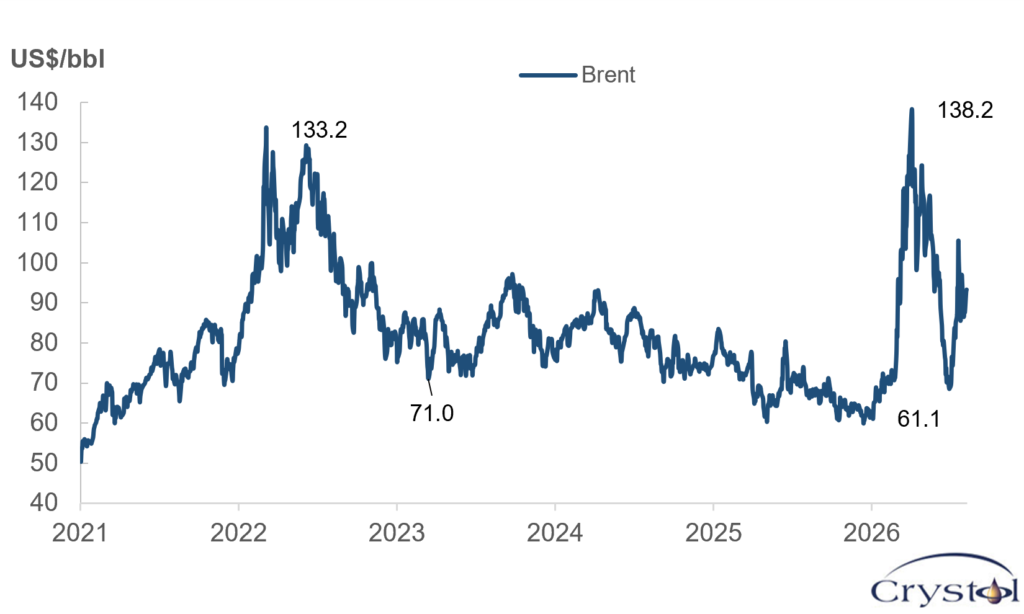
Source: Energy Information Administration
Why offshore matters
Offshore oil and gas production has become an important part of global energy supply, accounting for around 30 percent and 32 percent of global oil and gas production, respectively. Its importance is expected to grow further as many of the world’s most promising conventional oil and gas deposits are located beneath the seas, often in deepwater and ultra-deepwater basins.
This is the result of decades of technological progress. Offshore production was once largely confined to shallow waters close to shore, but advances in engineering steadily expanded operations into deeper and more complex environments. Water depths once regarded as technically challenging are now routinely developed, while projects increasingly extend beyond 1,500 meters into ultra-deepwater and, in some cases, exceed 3,000 meters. The industry is already preparing to work in even deeper waters, further expanding the range of commercially viable resources.
Deepwater production now sits at the center of offshore growth. Many of the world’s largest oil and gas discoveries have recently been made in deepwater and ultra-deepwater areas, while some long-established extraction sites offer fewer large new discoveries than in the past. This has increased the strategic importance of deepwater production and strengthened expectations for continued growth. According to some industry estimates, deepwater output is expected to increase by more than 60 percent between 2022 and 2030.
Offshore supply is also becoming more geographically diversified. While established regions such as the North Sea and the Gulf of America continue to benefit from ongoing investment, technological improvements and new discoveries, newer producers are reshaping the global offshore landscape. Brazil has established itself as the world’s leading deepwater producer, with around 95 percent of its oil now produced offshore, largely from its pre-salt fields. Guyana has emerged as one of the world’s fastest-growing oil producers following a series of major offshore discoveries, while Namibia has become one of the industry’s most closely watched exploration frontiers.
Offshore projects differ widely in their technical complexity and capital requirements. While some are located close to shore and linked to existing infrastructure, others operate in remote deepwater environments requiring substantial upfront investment, advanced technology and long development timelines. Although technological progress has improved project economics, offshore developments remain capital intensive and technically demanding. These characteristics help explain why deepwater projects are rarely undertaken by national oil companies alone. They are typically developed either by major international oil companies or through private-public partnerships, combining financial strength, technological expertise and risk-sharing.
Different economic models
Despite the growing importance of offshore resources, onshore developments still attract the majority of global upstream investment. This reflects both history and economics.
Oil production began onshore in the 19th century, while offshore development only started to expand on a meaningful scale in the 1960s and accelerated after the oil crises of the 1970s as producers sought new sources of supply, following the wave of nationalization in key producing regions such as the Middle East. Today, onshore remains the more established part of the industry, benefiting from mature infrastructure and generally lower development costs while involving fewer technical, logistical and environmental challenges than offshore developments. These advantages are reflected in investment patterns, with onshore accounting for around two-thirds of global upstream investment.
Offshore production, however, operates under a different economic model, with its own advantages and constraints. As such, this typically targets larger reservoirs, higher production volumes and longer production timelines, creating a different balance between risk, cost and long-term returns than with onshore sites.
Offshore economics are driven by scale. Compared with conventional onshore developments, undersea production is typically concentrated in a much smaller number of larger and more productive reservoirs. This enables operators to spread the substantial upfront investment across much larger production volumes, reducing per barrel development costs over the life of a project.
The opportunity to develop such large accumulations remains considerably greater offshore than onshore. While many onshore basins have been extensively explored for more than a century, large parts of the offshore domain − particularly in deepwater and ultra-deepwater − were comparatively underexplored until recently. In 2024, 85 percent of all new discoveries by volume were concentrated in just 10 offshore fields.
Offshore fields generally decline faster after reaching peak production than conventional onshore fields. This reflects the economics of offshore developments, where production is concentrated in fewer, highly productive wells designed to recover substantial upfront investment over a shorter period. However, offshore fields typically sustain high production over much longer periods. Furthermore, the comparison changes when offshore is measured against onshore shale production, which requires continuous drilling simply to maintain production.
Environmental considerations provide another important point of comparison. Offshore operations are often associated with the risk of major oil spills, reflecting several high-profile accidents that transformed regulation. Today, offshore developments are subject to some of the most stringent engineering, safety and environmental standards in the energy sector, requiring extensive monitoring, redundant safety systems and advanced technologies to minimize risks.
Environmental performance presents another, often overlooked, dimension. Although results vary across regions and operating conditions, modern deepwater operations have lower carbon intensity than many onshore operations. High well productivity means more hydrocarbons are produced for the same operational energy input, while newer facilities generally minimize flaring and methane emissions. In countries such as Norway, electrification of offshore platforms has lowered emissions further. Environmental performance has therefore become another dimension on which offshore projects increasingly compete.
Different economic models
The investment case for offshore was already strengthening before the 2026 Middle East conflict. Technological progress, improved project economics and a series of major offshore discoveries had boosted interest in deepwater projects despite relatively subdued long-term oil price expectations. Norwegian analysts at Rystad Energy projected deepwater investment to increase from around $90 billion in 2023 to almost $130 billion by 2027. All upstream projects globally reaching Final Investment Decision in 2024 were offshore developments.
This momentum was reflected across key producing regions. In October 2024, Nigeria introduced new fiscal incentives for deep offshore oil and gas developments to improve the competitiveness of its offshore sector and attract fresh investment. One month later, Petrobras approved a $111 billion investment program for 2025-2029, allocating around $77 billion to exploration and production, largely focused on its offshore pre-salt assets. Around the same time, Angola announced a new multi-year licensing strategy and fiscal measures aimed at encouraging investment in its offshore sector, particularly mature producing areas.
Meanwhile, companies continued to pursue frontier exploration in emerging offshore provinces such as Namibia’s, where successive major discoveries by international energy majors reinforced the industry’s willingness to invest in high-risk, underexplored basins despite moderate long-term oil price expectations.
The war in Iran and current developments
The Iran conflict itself did not fundamentally alter this investment case. Although oil prices rose sharply following the outbreak of hostilities, the increase proved relatively short-lived and was insufficient to change the economics of projects whose investment horizons are measured in decades rather than months. More importantly, long-term oil price expectations changed little, suggesting that investors have viewed the conflict as a temporary geopolitical shock rather than a structural change in market fundamentals. Offshore developments require years of appraisal, planning and construction before first production, making them far less responsive to temporary price movements than short-cycle investments.
Where the conflict appears to have had a greater impact is in reinforcing the strategic importance of offshore resources. Governments have sought to capitalize on renewed concerns over energy security and supply resilience by strengthening policies aimed at attracting offshore investment. Nigeria continued to promote its fiscal reforms and offshore opportunities, while the U.S. reaffirmed and expanded its offshore leasing program in the Gulf of America to provide greater long-term policy certainty for investors. Norway likewise maintained strong investment momentum on its continental shelf, with producers raising investment plans despite a softer oil price environment.
Rather than creating a new offshore investment cycle, the conflict appears to have reinforced and, in some cases, accelerated strategic and policy trends that were already underway.
Scenarios
More likely: Offshore continues to strengthen its position
The technological and commercial progress achieved over the past two decades, together with continued success in frontier exploration and the concentration of large discoveries in deepwater basins, sustain industry interest even without exceptionally high oil prices. The Middle East conflict reinforces this trajectory by increasing the strategic value of geographically diversified and resilient sources of supply, but it does not fundamentally alter the investment case.
International oil companies remain at the center of offshore expansion, drawing on their financial strength, technological capabilities and project management expertise to develop increasingly complex deepwater resources, either independently or in partnership with national oil companies. Competition for capital nevertheless intensifies. Success increasingly depends on maintaining cost discipline, improving productivity and continuing technological innovation, while governments compete to provide attractive fiscal regimes, regulatory certainty and regular access to exploration acreage.
Less likely: Offshore remains important but its edge gradually erodes
Cost inflation, supply-chain constraints and diminishing productivity gains make new projects increasingly expensive, while technological progress slows. At the same time, governments fail to match the industry’s evolving needs with sufficiently competitive fiscal terms, predictable regulation and efficient licensing processes. As returns weaken, international oil companies concentrate investment in only the most promising offshore projects while redirecting capital towards those offering stronger commercial returns. Offshore continues to play an important role in global supply, but expansion slows and the development of frontier deepwater resources becomes more limited.
Related Analysis
“Global oil market dynamics after U.S. intervention in Venezuela“, Dr Carole Nakhle, Jan 2026
Related Comments
“The Saudi oil pipeline the world didn’t know it needed“, Dr Carole Nakhle, Mar 2026
“US eases sanctions on Russian oil amid energy crisis sparked by Iran conflict“, Christof Rühl, Mar 2026
“War puts key Iranian oil terminals at risk“, Dr Carole Nakhle, Mar 2026