



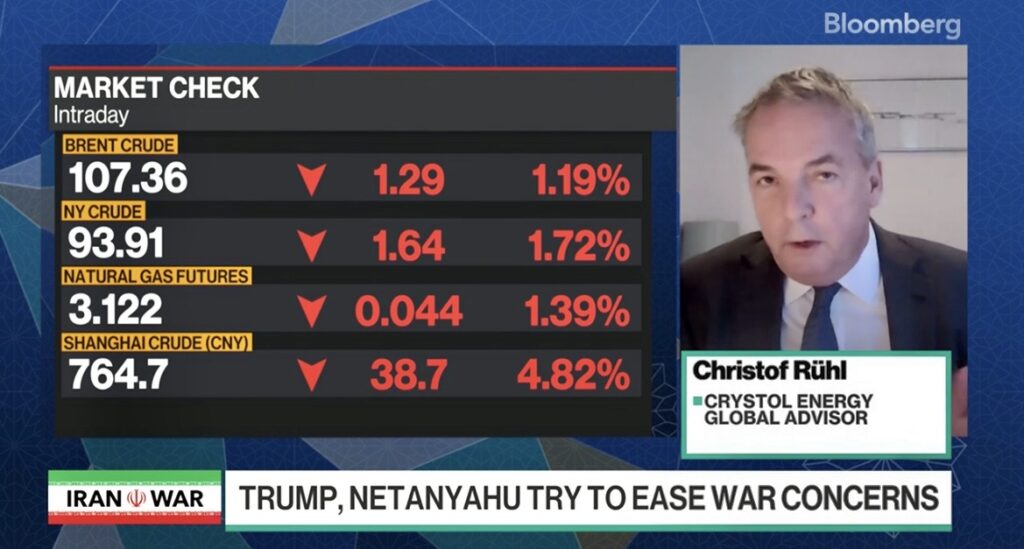
Christof Rühl, Global Advisor At Crystol Energy, joined Joumanna Bercetche on Bloomberg to discuss the latest energy market disruption and what is really driving prices higher. The interview focused on why current market stress reflects fears of a wider and longer conflict rather than severe physical shortages today, how quickly oil and gas markets could stabilise if de escalation occurs, and why Russia appears to be the main beneficiary of the current crisis.
Key takeaways:
Oil prices are being driven mainly by fears of further escalation and future disruption, not by a major lasting supply shortage at this stage.
The most important market signal is that the conflict has shown an ability to target selected energy assets, which raises concerns that disruption could continue or spread.
If a ceasefire were announced quickly and the Strait reopened, oil markets could move back relatively fast to the oversupplied conditions that existed before the attacks.
Gas markets would likely take longer than oil markets to normalise, but the current level of disruption remains manageable as long as damage stays limited.
The current price reaction reflects political and geopolitical uncertainty more than physical destruction across the energy system.
Compared with the shock that followed Russia’s invasion of Ukraine, the present disruption remains smaller because the physical damage so far is still contained.
The longer the conflict lasts, the more likely markets are to price in a sustained geopolitical premium and greater economic risk.
Russia stands out as the clearest short term winner, as higher prices and easier access to buyers improve its oil revenues after tighter sanctions had started to hurt.
Related Comments
“Iran War: Asia most at risk in an LNG shortage“, Christof Rühl, Mar 2026
“US and Israel launch major military strikes on oil-rich Iran“, Dr Carole Nakhle, Feb 2026