



More than two months after the start of the war on Iran, the Strait of Hormuz remains effectively blocked. Oil inventories, the buffer which has helped to avoid global shortages so far, are being drawn down fast. Alarm bells are ringing about higher prices damaging the global economy.
But how exactly will this look like? Is the comparison with past oil price shocks still useful, now that oil consumption has become so much smaller as a share of GDP?
2026 GDP Growth Outlook: January vs April Forecasts
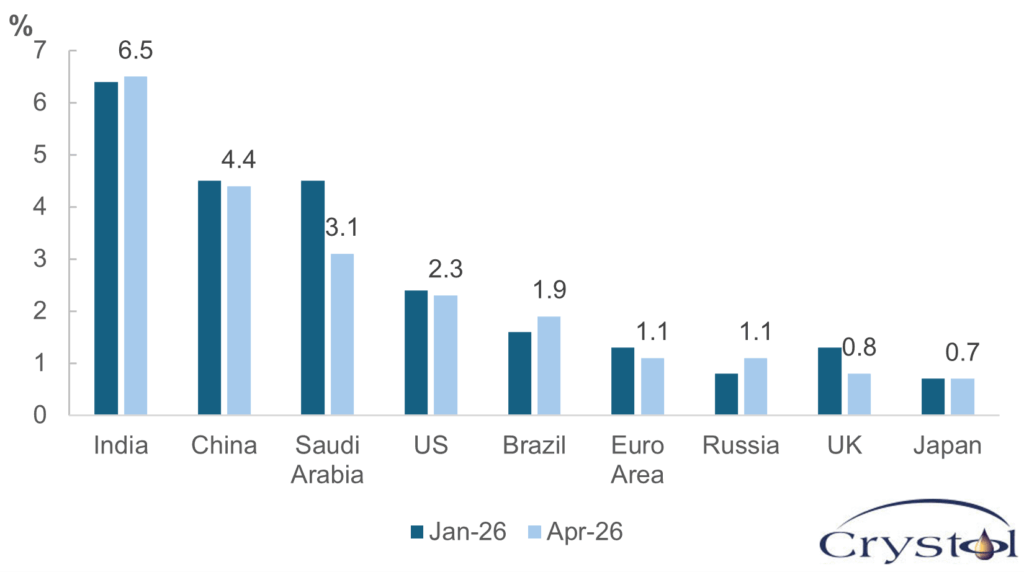
Source: International Monetary Fund
The following op-ed in the Financial Times (May 5) by Christof Rühl, Global Advisor at Crystol Energy, discusses the mechanisms by which modern economies may be affected. It argues that it may indeed be different this time. But this doesn’t mean it will be easier.
Related Analysis
“Global oil market dynamics after U.S. intervention in Venezuela“, Dr Carole Nakhle, Jan 2026
Related Comments
“The Saudi oil pipeline the world didn’t know it needed“, Dr Carole Nakhle, Mar 2026
“US eases sanctions on Russian oil amid energy crisis sparked by Iran conflict“, Christof Rühl, Mar 2026
“War puts key Iranian oil terminals at risk“, Dr Carole Nakhle, Mar 2026