


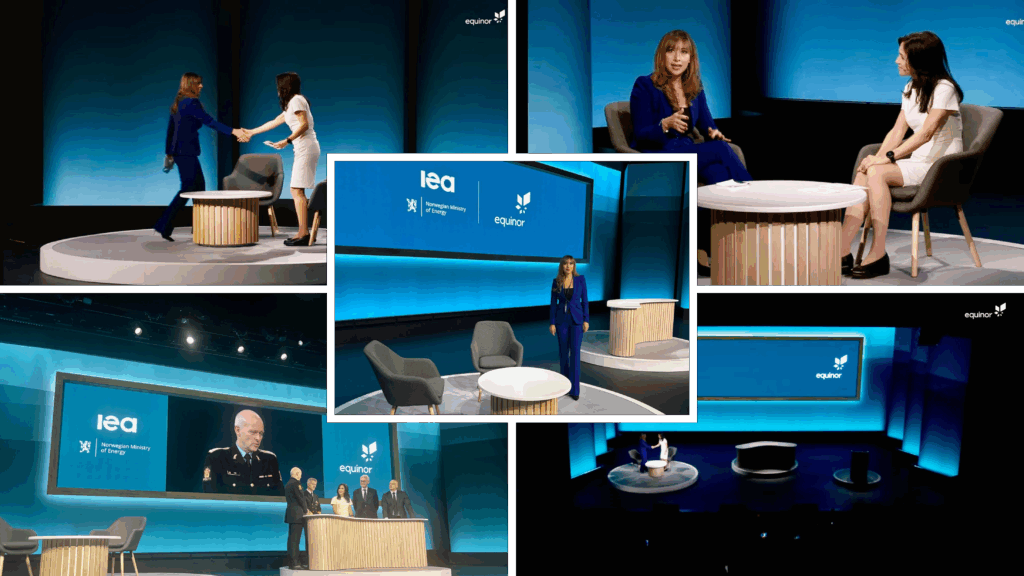
Crystol Energy CEO Dr Carole Nakhle spoke at the Equinor 2025 Autumn Conference in Oslo, a joint event hosted by Equinor, Norwegian Ministry of Energy and the International Energy Agency (IEA).
In a fireside chat with Norwegian journalist Siri Lill Mannes, she shared insights on the latest edition of the IEA World Energy Outlook and how to read it beyond the headlines. The discussion focused on what the report is, what it is not, and why that distinction matters for governments, companies and investors.
Key takeaways
The World Energy Outlook presents scenarios, not firm forecasts. It explores what could happen under different policy and market assumptions instead of predicting a single future.
The scenarios are conditional pathways rather than policy prescriptions. Their main value is to test choices and trade offs, not to give one fixed long term expectation.
United States shale production shows how real outcomes can surprise. Earlier editions pointed to insignificant contribution of U.S. shale and falling output, yet today production stands above thirteen million barrels per day.
The narrative around natural gas keeps evolving. Past editions spoke about a possible golden age of gas, while more recent work questions how long that age can last and notes a potential fifty percent rise in global liquefied natural gas capacity by twenty thirty.
In the Current Policies Scenario, oil and gas demand does not peak before 2050. The real issue is to understand how long any demand plateau may last and what comes after it.
Critical minerals and electricity access remain key pressure points. Supply of many minerals is concentrated in a few countries, which raises the risk of resource nationalism. At the same time, large gaps in access to power persist in many parts of Africa and even within the Middle East.
The wider conference featured keynote speeches by Norwegian Minister of Energy Terje Aasland, IEA Executive Director Dr Fatih Birol and Equinor CEO Anders Opedal. In addition, military and police personnel and NATO representatives shared their views. Together they offered a broad view on energy security, climate policy and the links between energy and geopolitics.
Overall, the event provided a valuable forum for open discussion on the role of scenarios, the limits of long range projections and the need to ground energy policy in evidence and experience while keeping uncertainty in mind.
Related Comments
“IEA: oil and gas demand to grow for the next 25 years“, Dr Carole Nakhle, Nov 2025
Related Analysis
““No concern at all”: The economist’s view”, Dr Carole Nakhle, Sep 2025