



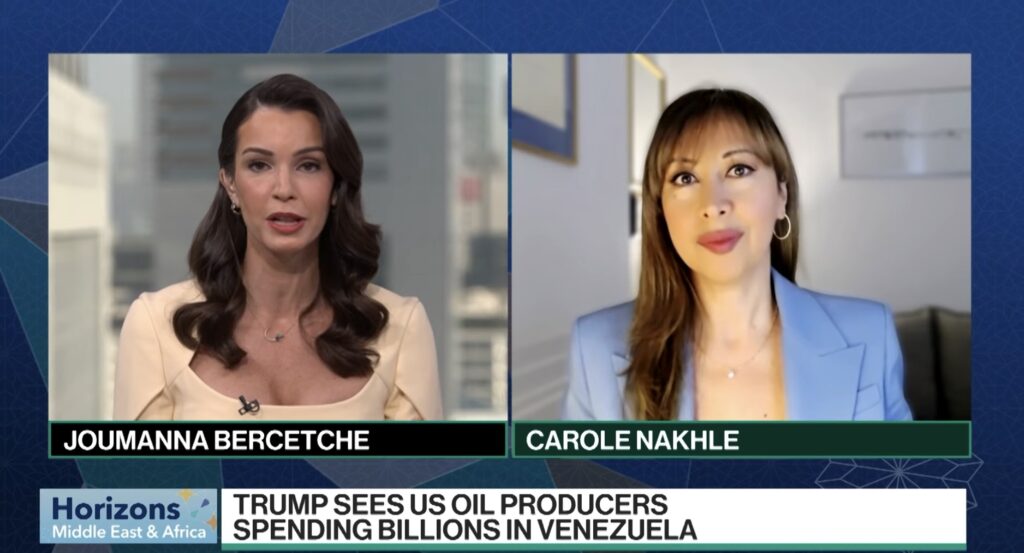
In an interview with Joumana Bercetche from Bloomberg, Dr. Carole Nakhle, CEO of Crystol Energy, explained why Venezuela’s oil story is shaped above ground by policy, capacity, and geopolitics, and what that could mean for oil prices in 2026.
Key takeaways:
A return to past production levels in Venezuela is possible in theory, but it would take years and remains uncertain, as seen in other recovery cases such as Iraq.
The sharp decline in Venezuela was driven mainly by above ground factors, not geology, and not sanctions alone, with the structural weakening of the sector starting well before sanctions.
Policy shifts under Hugo Chávez changed the investment climate through tougher terms, nationalisation pressures, and legal disputes, which contributed to a long lasting loss of confidence and capital.
Operational capacity deteriorated after deep institutional disruption and the loss of technical expertise, which is why rebuilding output is a slow process even if conditions improve.
Sanctions relief could bring some additional barrels back to market, but the most realistic near term outcome is a few hundred thousand barrels rather than a supply surge that shifts global balances.
The size of reserves does not determine market influence, because governance, contracts, and legal frameworks above ground decide whether reserves can translate into reliable production.
Direct intervention by a major power is rare and closely watched, and it raises geopolitical uncertainty while sending a signal to other sanctioned producers such as Russia and Iran.
Oil prices remain anchored by fundamentals and surplus expectations, so extra barrels would add downside pressure, while OPEC’s cautious stance reflects a preference to wait for clearer signals.
Related Comments
“OPEC reality check and shifting oil narratives“, Dr Carole Nakhle, Nov 2025
“China oil stockpiling and global energy security“, Dr Carole Nakhle, Nov 2025