




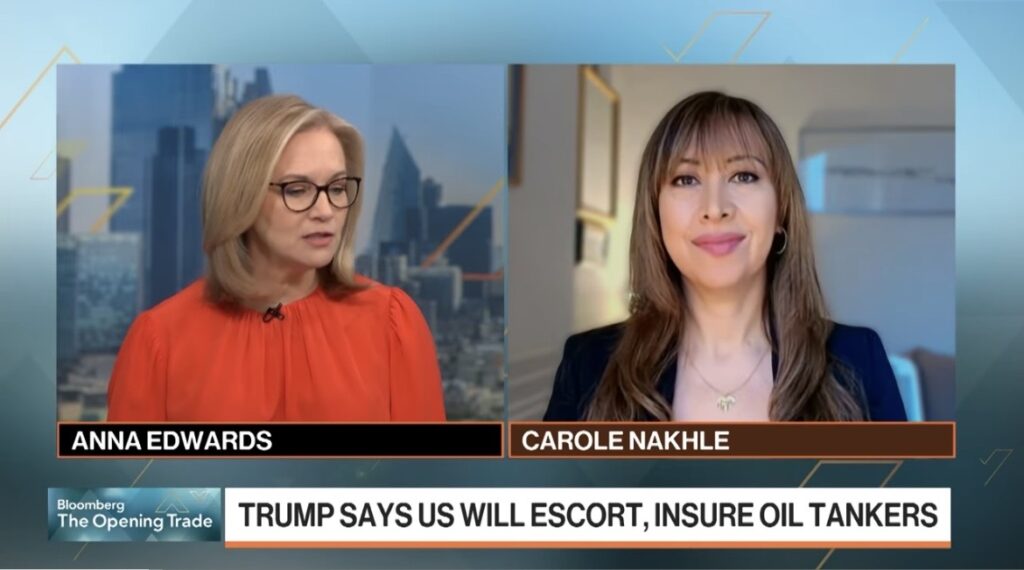
Dr. Carole Nakhle, CEO of Crystol Energy, joined Bloomberg with Tom Mackenzie and Anna Edwards to discuss President Trump’s proposal to provide insurance and naval escort for shipping through the Strait of Hormuz, and what it could mean for oil markets.
In the interview, Carole Nakhle explains why the initial price relief proved short-lived and why market attention remains focused on escalation risks. She notes that while protection measures can ease market fears, they do not eliminate operational risk, particularly if the conflict expands and attacks spread to energy infrastructure in neighbouring producing countries.
Key takeaways:
Naval escort and political risk insurance can ease pressure, but practical implementation and appetite to sail remain uncertain.
Even if tanker traffic resumes, a return to normal conditions looks unlikely while drones and strikes remain a threat.
The most worrying scenario comes from attacks on regional energy infrastructure and the risk of GCC countries being drawn into the conflict.
A two tier market for flows looks hard to enforce, because risk in a narrow waterway affects shipping behaviour more broadly.
Oil prices show a justified risk premium, but the market is not in panic because a large global deficit is not yet evident.
Supply cushions exist, including potential production response outside OPEC+ and emergency stock releases if disruptions intensify.
Some sanctioned barrels could add flexibility at the margin, which may help limit panic even if it does not solve logistics.
Alternative routes and regional land infrastructure can divert several million barrels per day, but ramp up takes time and demand may soften as prices rise.
Market analysis should not focus solely on supply risks; higher prices can also affect demand growth and therefore shape market dynamics.
Related Comments
“Iran War: Asia most at risk in an LNG shortage“, Christof Rühl, Mar 2026
“US and Israel launch major military strikes on oil-rich Iran“, Dr Carole Nakhle, Feb 2026