


Dr Carole Nakhle
Syria has been a relatively modest, but not insignificant, oil and gas producer in a region that hosts some of the world’s largest hydrocarbon reserves. However, more than a decade of conflict has sharply reduced its production, damaged its infrastructure and deterred investment.
Today, Syria’s importance to regional energy markets may increasingly lie not only in what it can produce, but also in its location, sitting at the crossroads of the Middle East, the Eastern Mediterranean and routes toward Europe.
The war in the Gulf and the disruption to shipping through the Strait of Hormuz have increased the value of alternative routes that bypass the strait. For Syria, in particular, the United States-Iran conflict is reviving its role as a strategic transit corridor for regional energy trade. Iraq is already using Syria to access Mediterranean export terminals, albeit by road and on a small scale, demonstrating its potential as an alternative route that reduces reliance on the Strait of Hormuz. Plans to expand the Iraq-Syria oil corridor have gained momentum.
Damascus is trying to capitalize on this momentum. It is seeking foreign investment to rehabilitate its own oil and gas industry while promoting Syria as a potential regional energy corridor. Syrian officials have become increasingly visible at major international energy gatherings, and companies from the Gulf and the U.S. are exploring opportunities in the country. Importantly, these efforts are taking place with the backing of a U.S. administration that has supported Syria’s economic reintegration and the development of alternative regional energy routes.
The question is whether Syria can turn that advantage into a lasting role in regional energy trade. Much will depend on security and political stability, the investment framework at home, the durability of international support and Syria’s ability to compete for capital in an increasingly selective global oil and gas market.
Oil Production
Oil production started in Syria in 1968, with a more significant phase of development beginning in the 1980s, when the country opened its sector to international oil companies. A series of discoveries followed, supporting a steady increase in production which peaked in 2002 at around 672,000 barrels per day (b/d). After this time, output entered a gradual structural decline. Exploration activity also slowed significantly, falling by 2009 to less than a third of the level recorded during the early-1990s exploration boom.
Geology was partly responsible. Many of Syria’s larger producing fields were maturing, while new discoveries tended to be smaller and insufficient to replace declining production. But geology alone does not explain the decline; the government did not sufficiently adapt the terms offered to investors to the higher costs and risks of exploring and developing more challenging resources, thereby limiting investment. Growing political tensions with Western countries and sanctions further weakened the investment environment.
The outbreak of the civil war in 2011 dramatically accelerated the decline. Damage to infrastructure, the withdrawal of international oil companies, sanctions and fragmented territorial control led to a collapse in production. From around 353,000 b/d before the conflict, Syria’s oil output nearly came to a halt in 2018 and remained extremely limited for several years. By 2025, production was estimated at only around 34,000 b/d.
As output fell sharply during the conflict, Syria increasingly relied on crude imports, particularly to supply its domestic refineries, turning the country from a net crude exporter into an importer.
Gas Production
Gas production began in 1976 and expanded steadily as the government sought to reduce reliance on oil for power generation. Output peaked at around 8.4 billion cubic meters (bcm) in 2010. Numerous small discoveries were made over this period, although domestic gas pricing constrained investment in their development.
Gas production declined following the outbreak of the war, but considerably less sharply than oil. Most major gas fields are located in central Syria, which remained largely under government control and was less affected by fighting. By contrast, much of Syria’s oil production was concentrated in the northeast, where hostilities were more intense and many installations fell outside government control for several years.
The government also prioritized gas production because of its importance for electricity generation, while gas infrastructure suffered less extensive damage than oil facilities. These factors allowed parts of the sector to continue operating despite the conflict. In 2025, Syria produced approximately 3.3 bcm of natural gas, less than 40 percent of its pre-war peak.
Syria’s oil and gas production
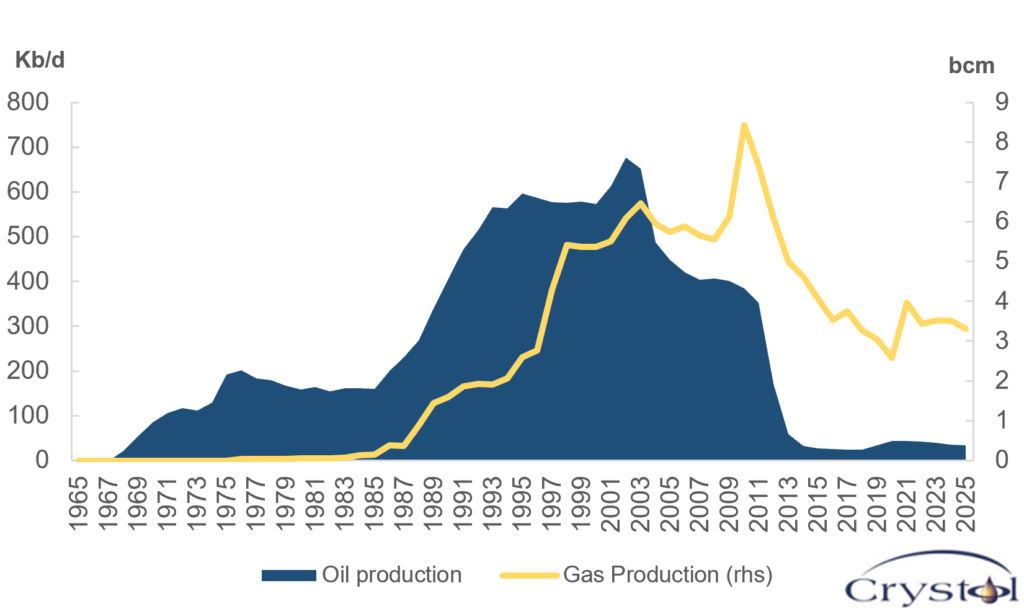
Source: Energy Institute
A new chapter
The removal of the Assad regime in late 2024 opened a new chapter for Syria’s oil and gas industry. The shift is taking place on several fronts. By early 2026, the government had regained control over major oil and gas assets and facilities previously held by non-state actors, chiefly the Kurdish-led Syrian Democratic Forces in the northeast.
The country has also adopted a more open approach to foreign investment, while international political support has made it easier for foreign companies to consider opportunities that were effectively closed to them for years.
The U.S. removed its broad Syria sanctions program in 2025, while the Caesar Syria Civilian Protection Act, enacted in 2019 in response to abuses committed by the Assad government and designed to impose sanctions on those providing significant support to it, was repealed in December 2025. In August 2026, Washington also rescinded Syria’s designation as a State Sponsor of Terrorism.
The U.S. administration has explicitly linked these measures to facilitating investment and Syria’s economic reintegration. The political message from Washington has been openly supportive. Following Syrian President Ahmed al-Sharaa’s visit to the White House in November 2025, President Donald Trump said the U.S. would “do everything we can to make Syria successful.” However, U.S. support has been conditional, with Washington linking its continued engagement to the new government’s actions on security, counterterrorism and regional stability.
Gulf countries have also become important partners in Syria’s reconstruction, including in energy, with companies from Saudi Arabia, Qatar and the United Arab Emirates exploring or committing to projects across oil, gas, power and infrastructure.
For now, the primary focus appears to be on rebuilding Syria’s energy system and restoring domestic production. Producing fields, pipelines, processing facilities, refineries and export infrastructure all require repair and modernization after years of conflict and underinvestment. Restoring existing capacity could increase Syria’s production more quickly while helping reduce its dependence on imported energy and make better use of its existing refining and export infrastructure. Additional gas production would have an obvious domestic market given the country’s electricity shortages.
Syria is also assessing its offshore potential. Unlike its Eastern Mediterranean neighbors, Syria has not yet explored its waters. In February 2026, the Syrian Petroleum Company (SPC), a fully state-owned holding company established in 2025 to consolidate the state’s oil and refining interests, signed a memorandum of understanding (MoU) with U.S. major Chevron and Qatar’s UCC Holding to begin evaluating offshore oil and gas exploration.
Then in May 2026, SPC signed another MoU with U.S.-based ConocoPhillips, France’s TotalEnergies and QatarEnergy, also covering offshore oil and gas exploration. Although not all MoUs will translate into actual commitments, the involvement of these major international energy companies is significant at this critical stage for Syria, as the country rebuilds its economy and seeks to reestablish itself internationally after more than five decades of Assad family rule.
Reviving Syria’s transit role
Syria’s integration into the region’s energy network is not new. As early as the 1930s, pipelines developed by the Iraq Petroleum Company carried Iraqi crude from Kirkuk westward across Syrian territory to the Mediterranean, initially through Lebanon’s port of Tripoli. In 1952, the Kirkuk-Baniyas pipeline gave Iraq a direct outlet on Syria’s Mediterranean coast and established Syria as an important link between Iraqi production and international markets.
That role diminished as political disputes and wars disrupted cross-border flows. Today, however, the disruption in the Strait of Hormuz has given renewed urgency to restoring it. In July 2026, Syria and Iraq agreed to revive the historic Kirkuk-Baniyas corridor. The current project focuses on the section between Haditha, a pipeline junction in western Iraq, and Baniyas.
More importantly, Iraq is considering connecting Haditha to its much larger producing areas in the south. This could allow crude from Basra to reach the Mediterranean through Syria, reducing dependence on Hormuz. Syrian Energy Minister Mohammad al-Bashir described the project as a way to “reinforce Syria’s position as a regional energy corridor linking the region’s resources to the Mediterranean.”
According to the U.S. State Department, the rehabilitated Iraq-Syria route could initially transport up to 2 million b/d (mb/d). That would be significant, amounting to nearly 60 percent of Iraq’s oil exports before the Hormuz conflict, although the figure refers to proposed capacity rather than expected flows and the eventual configuration of the network remains under study. Meanwhile, the Syrian route is already being used on a much smaller scale. Iraqi petroleum products are being transported by truck across Syria to Baniyas for export from the Mediterranean.
Syria’s potential as an energy corridor is not limited to oil. The Arab Gas Pipeline connects Syria southward with Jordan and Egypt and westward with Lebanon, while Syria is also connected northward to Turkiye. Since August 2025, Azerbaijani gas has been supplied to Syria through Turkiye via the restored Kilis-Aleppo connection. Together, these links give Syria the foundations of a north-south gas network alongside the prospective east-west oil corridor between Iraq and the Mediterranean.
The economic opportunity could also extend beyond collecting transit fees. Iraqi crude reaching Syria could be exported directly from Baniyas, but some could potentially be processed domestically if future commercial arrangements and refinery configurations permit. Syria has refineries at Baniyas and Homs, as well as storage and Mediterranean export facilities. Rehabilitation of these assets could therefore allow Syria to capture additional value from regional flows through refining, storage, port services and petroleum-product exports.
However, much of Syria’s oil and gas infrastructure was built decades ago; parts have been out of operation for years, maintenance and investment have been inadequate, and some facilities suffered significant damage during the civil war and would require varying degrees of rehabilitation and modernization. Handling anything approaching the volumes now being discussed would require considerable capital and, more importantly, a long-term commitment from investors and neighboring countries that extends well beyond the current disruption in the Gulf.
Scenarios
More likely: Momentum is sustained
International interest in Syria continues, supported by its strategic location, reconstruction needs and closer economic integration with its neighbors. U.S. and Gulf backing remains important. Damascus succeeds in converting major MoUs into actual investment. Progress on the investment framework, institutional capacity, transparency and controlling corruption would strengthen investor confidence. Energy production gradually recovers and some regional infrastructure projects move forward, allowing Syria to establish a growing role in regional energy trade.
Transit fees, refining and port services would give Damascus a new source of revenue, and higher gas output would help ease the country’s electricity shortages. For Iraq, a working outlet to the Mediterranean would reduce its exposure to future disruptions in the Gulf.
Less likely: Interest fades
Syria struggles to convert international interest into sustained investment. Political and security instability, slow reforms, weak institutions and corruption discourage companies from committing substantial capital, while failure to meet U.S. expectations could weaken Washington’s support. Urgency behind alternative export routes diminishes. Domestic energy production does not recover, while major pipeline and infrastructure projects are delayed or scaled back, leaving Syria’s ambition to become a significant regional energy corridor largely unrealized.
Related Analysis
“Global oil market dynamics after U.S. intervention in Venezuela“, Dr Carole Nakhle, Jan 2026
Related Comments
“The Saudi oil pipeline the world didn’t know it needed“, Dr Carole Nakhle, Mar 2026
“US eases sanctions on Russian oil amid energy crisis sparked by Iran conflict“, Christof Rühl, Mar 2026
“War puts key Iranian oil terminals at risk“, Dr Carole Nakhle, Mar 2026