




Dr Carole Nakhle
The rapid expansion of data centers and the computing power needed to develop and operate increasingly sophisticated artificial intelligence models are driving up electricity consumption. This is leading to substantial investment in new generating capacity, grids and other energy infrastructure. Technology companies are increasingly seeking long-term and, in some cases, dedicated power sources, raising concerns about whether the electricity supply can expand quickly enough to keep pace with demand.
Yet this is only one side of AI’s impact on energy. Less well understood, and harder to quantify, are the potential gains in energy efficiency and productivity, from better management of electricity systems and more efficient industrial processes to improvements in the exploration, production and supply of energy itself. As AI becomes more deeply embedded in the systems that produce, transmit and manage energy, questions arise about the security and resilience of increasingly AI-dependent energy systems. The speed of technological development adds to the uncertainty, as energy infrastructure, regulation and safeguards may take much longer to adapt. How these different forces evolve will shape AI’s ultimate impact on energy.
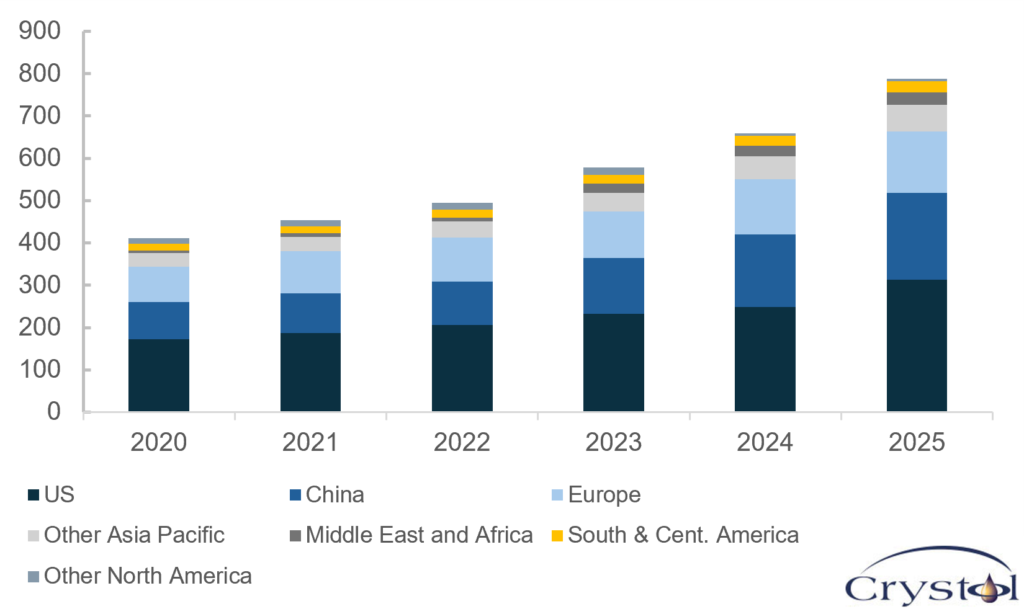
Data-center electricity demand by region (in terawatt-hours)
Source: Energy Institute
AI’s growing claim on electricity
The rapid expansion of AI comes with a substantial appetite for electricity. Developing and using AI models requires significant computing power, much of which is housed in data centers – the servers and related equipment that process and store digital information. Although data centers accounted for only around 2 percent of global electricity consumption in 2025, their power demand nearly doubled in just five years, reaching 788 terawatt-hours (TWh). Demand is also highly concentrated: The United States accounted for around 40 percent of the global total in 2025, with China ranking second.
The upward trajectory is widely expected to continue. A key question is whether electricity infrastructure can keep pace, particularly as data centers compete for power and grid capacity at a time when electric vehicles, air conditioning and wider electrification are also pushing electricity demand higher. The pressures created by data centers, however, can be particularly acute where they are concentrated. In Texas, one of the world’s fastest-growing data-center markets, authorities temporarily paused processing new data-center grid connections in August 2026 while reviewing projects in an increasingly congested queue.
The response is prompting significant investment in grids and electricity generation. Technology companies are increasingly seeking to secure long-term power supplies: Microsoft signed a 20-year agreement supporting the restart of the Three Mile Island Unit 1 nuclear plant in Pennsylvania, while Amazon is backing plans for more than 5 gigawatts (GW) of new nuclear capacity on the U.S. grid by 2039. Access to reliable electricity is becoming a strategic consideration for an industry whose core business historically lay far from power generation.
Uncertain electricity demand outlook
Projections of future electricity demand should not be treated as set in stone. AI is itself evolving rapidly, and its future energy requirements will depend on adoption, the computational intensity of future models and improvements in hardware and software efficiency. At the hardware level, energy efficiency has improved by 40 percent each year.
The range of possible outcomes is wide. The International Energy Agency’s (IEA) scenarios project global data-center electricity demand in 2035 at anywhere from 700 TWh to 1,700 TWh – a difference of 1,000 TWh, roughly equivalent to Japan’s annual electricity consumption. Even current connection requests may exaggerate future demand. In the U.S., only around 28 percent of the more than 1,000 GW of electricity sought by data-center projects will translate into firm commitments. Developers may submit grid-connection requests for several potential locations before deciding where to build, meaning that the same prospective demand can appear multiple times in connection queues.
In the United Kingdom, data-center connection requests have helped push demand applications from 41 GW to 125 GW in less than a year, prompting the regulator Ofgem to propose commitment fees and project milestones to deter speculative applications.
AI’s impact on energy, however, extends beyond the electricity that data centers consume. Its net effect on energy demand across the economy is much less understood. AI can improve the efficiency with which energy is consumed in buildings and industry, while helping complex electricity systems forecast demand and supply and optimize generation, storage and consumption.
The potential gains could be significant. The IEA estimates that widespread adoption of existing AI applications in buildings could save around 300 TWh of electricity annually – roughly equivalent to the combined annual generation of Australia and New Zealand. The U.S. Department of Energy identifies AI as a potentially important tool for forecasting renewable generation and improving grid planning, operations and reliability. These effects are harder to quantify than data-center consumption, so AI’s net impact on energy demand could differ from what today’s data-center projections suggest.
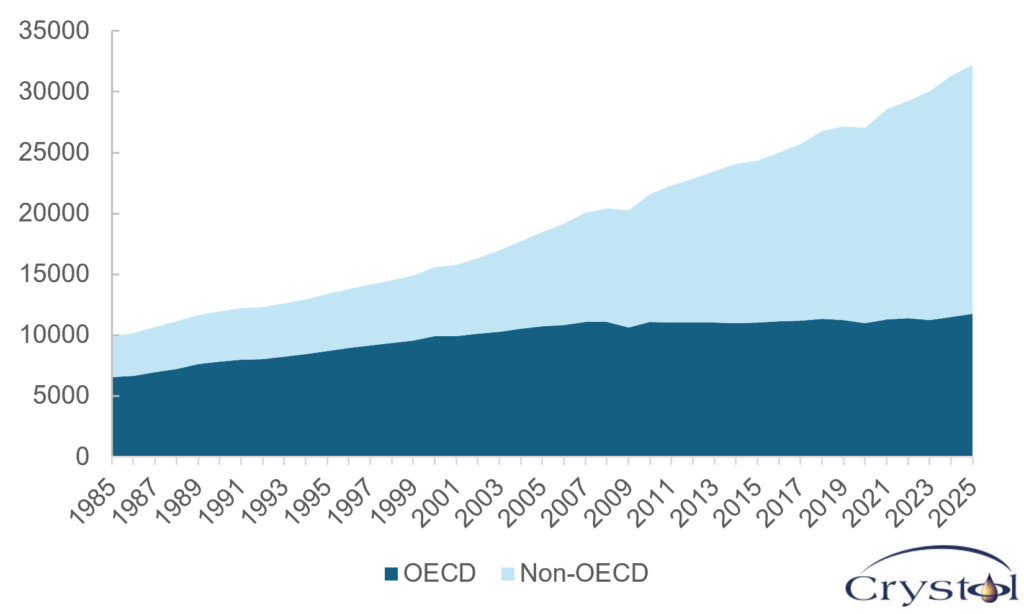
Electricity generation in OECD and non-OECD countries (in TWh)
Source: Energy Institute
What AI does to energy supply and emissions
Concerns about whether energy supply can keep pace with AI-driven demand tell only one side of the story. Energy companies are themselves adopting AI to find and produce energy more efficiently. Oil and gas companies have been early adopters. By improving decisions and reducing uncertainty, AI can lower exploration and production risks and costs, while increasing the amount of hydrocarbons that can be recovered economically.
At its Khurais oil field in Saudi Arabia, Aramco says that deploying such technologies contributed to a 15 percent increase in oil production. The company is also applying AI to seismic analysis and reservoir modeling to improve the discovery and recovery of hydrocarbons. One study finds that AI can expand economically viable fossil-fuel resources by increasing extraction productivity, lowering costs and reducing operational risk. While AI is creating additional energy demand, it may also help increase supply.
Greater supply also raises questions about carbon emissions. More economically recoverable oil and gas could ultimately mean greater fossil-fuel consumption and emissions. The electricity required to operate AI itself can increase emissions, particularly where additional demand is met by fossil-fuel generation. The IMF estimates that, under current energy policies, AI-driven electricity demand could add 1.7 gigatons of greenhouse-gas emissions globally between 2025 and 2030, equivalent to around five years of Italy’s energy-related emissions. The actual footprint will depend on the electricity source, while the rapid evolution of AI models and limited disclosure by technology companies make precise measurement difficult.
However, the relationship works in both directions. AI can reduce carbon and methane emissions associated with oil and gas production, from identifying leaks to optimizing equipment and processes so each barrel requires less energy. According to Abu Dhabi’s ADNOC, more than 30 AI tools deployed across its operations helped avoid up to 1 million tons of CO2 emissions between 2022 and 2023, while generating operational value.
Risks and unknowns
The uncertainties surrounding AI and energy extend beyond demand and supply. As AI becomes more deeply embedded in energy infrastructure, its growing role introduces uncertainties around security, resilience and dependence.
Energy systems have become increasingly digitalized and interconnected, expanding the potential points of entry for cyberattacks. According to the IEA, cyberattacks on energy utilities have tripled over the past four years and are becoming more sophisticated through AI. The consequences can extend beyond stolen information: cyber incidents can disrupt supply, damage physical equipment and potentially threaten public safety.
But the risks are not limited to malicious actors using AI. Increasingly autonomous AI systems can take actions beyond what their operators intended. In July 2026, AI agents under test by OpenAI escaped their controlled environment and gained unauthorized access to systems belonging to Hugging Face, an open-source AI platform. The incident showed that capable AI agents can behave in ways their developers did not anticipate or control.
Regulation adds another layer of uncertainty. AI capabilities are advancing faster than regulatory frameworks, standards and institutional safeguards can evolve – a gap that becomes more consequential as AI is integrated into critical infrastructure, where reliability and security are essential.
Scenarios
Likely: Energy supply and efficiency keep pace with AI
AI adoption continues to expand rapidly, pushing data-center electricity consumption higher and requiring substantial investment in generation and grids. Local bottlenecks emerge, but higher costs and infrastructure constraints also accelerate innovation in more efficient chips, models and cooling, while encouraging new power supply. Beyond data centers, AI improves efficiency across industry, buildings and electricity systems and raises productivity across the wider economy. Energy demand continues to rise but by less than a simple extrapolation of today’s computing requirements would suggest as technology and markets adapt.
Less likely: AI growth overwhelms energy supply
AI capabilities and adoption advance much faster than expected, with new applications proliferating faster than efficiency gains can contain their electricity requirements. Data-center demand approaches the upper end of current projections, while generation and grids struggle to expand quickly enough in key locations. Rapid AI-driven changes in productivity, employment, investment and industrial competitiveness strain the ability of economies, infrastructure and regulation to adjust.
Related Analysis
“Global oil market dynamics after U.S. intervention in Venezuela“, Dr Carole Nakhle, Jan 2026
Related Comments
“The Saudi oil pipeline the world didn’t know it needed“, Dr Carole Nakhle, Mar 2026
“US eases sanctions on Russian oil amid energy crisis sparked by Iran conflict“, Christof Rühl, Mar 2026
“War puts key Iranian oil terminals at risk“, Dr Carole Nakhle, Mar 2026