




Gastech 2026 Insights
Resilience has become one of the most widely used words in today’s energy debate. But what does it actually mean for a global LNG supply chain?
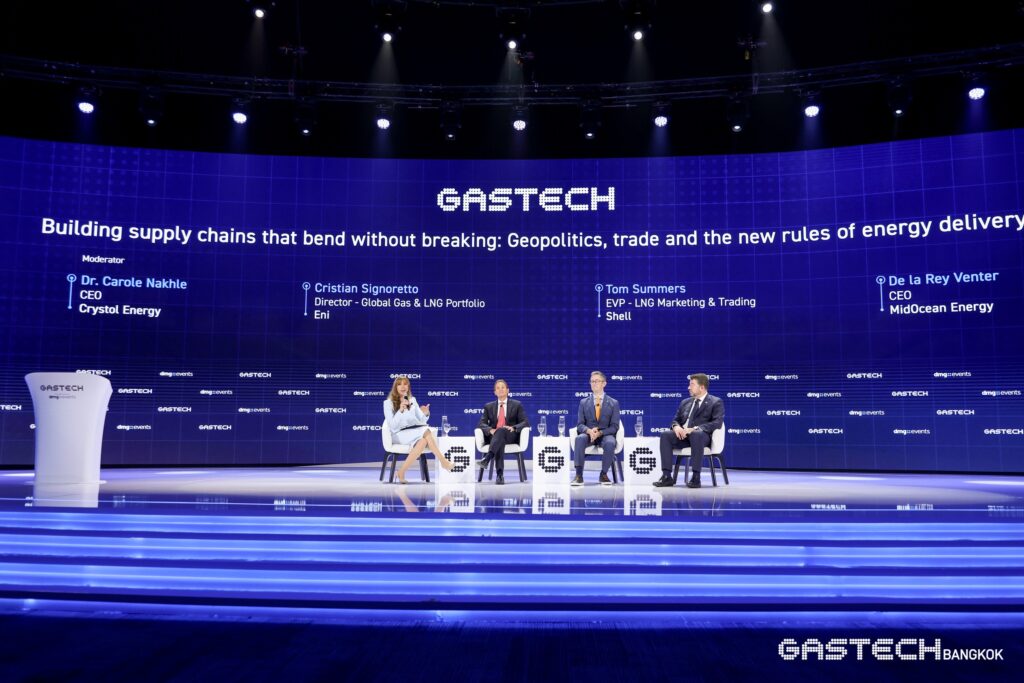
That question was at the heart of the Gastech 2026 Strategic Leadership panel, “Building supply chains that bend without breaking: Geopolitics, trade and the new rules of energy delivery,” moderated by Crystol Energy CEO Dr Carole Nakhle in Bangkok.
The discussion brought together Cristian Signoretto, Director – Global Gas & LNG Portfolio at Eni; Tom Summers, EVP – LNG Marketing & Trading at Shell; and De la Rey Venter, CEO of MidOcean Energy.
Resilience is the ability to adapt
For a supply chain, resilience can be defined quite simply: the ability to absorb a disruption, adapt to it and continue delivering energy. That distinction matters. Resilience does not mean eliminating disruption. Recent years have provided ample evidence that geopolitical shocks, physical chokepoints, trade tensions and other disruptions cannot simply be designed away.
The more relevant question is how the supply chain responds when they occur.
Not all disruptions are the same
LNG provides a particularly interesting case because its supply chain is truly global – from production and liquefaction to shipping and the infrastructure at the receiving end. A disruption in one part can quickly affect the rest.
But successive shocks have tested different parts of that chain in different ways. Disruption to a shipping route is not necessarily the same as disruption that affects the availability of supply itself. The discussion therefore looked at what recent experiences have revealed about both the vulnerabilities and resilience of the global LNG system.
Flexibility requires options
A recurring theme was the importance of having options.
Those options can take different forms: diversified sources of supply, flexibility in contracts and cargo destinations, access to shipping capacity, storage and regasification infrastructure, and the ability to redirect LNG between markets.
The discussion also highlighted that resilience cannot be considered separately from economics. Companies and buyers still have to balance security and diversification against efficiency and delivered cost.
Resilience is also about what comes next
The panel looked beyond the lessons from recent disruptions to how companies are adapting their strategies and portfolios, what still needs to change, and the respective roles of industry and governments.
Investment in infrastructure, the functioning of the global LNG market and cooperation between governments and industry will all influence how supply chains evolve as geopolitical and trading patterns continue to change.
As Dr Nakhle concluded:
“Resilience is not about avoiding disruption – that is simply not realistic. It is about having enough options to adapt when disruption comes.”
This article is part of Crystol Energy’s Gastech 2026 Insights series, drawing on the discussions and themes explored during the conference in Bangkok.
Related Events
“Crystol Energy Delivers Keynote at IPIECA Week in London“, Apr 2026
“Carole Nakhle on Energy, Geopolitics, and Talent at Arab Women Business Forum, London“, Apr 2026
“Dr Carole Nakhle joins Energy Connects Global Advisory Board“, Jan 2026
“Crystol Energy leads strategic LNG discussions at the World LNG Summit in Istanbul“, Dec 2025