


Gastech 2026 Insights
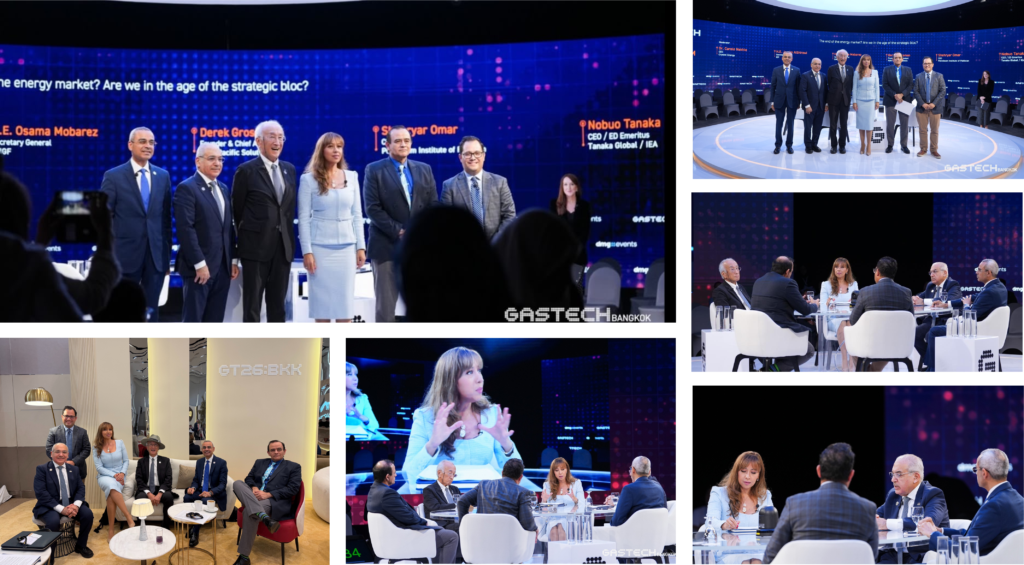
At Gastech 2026 in Bangkok, Crystol Energy CEO Dr Carole Nakhle moderated an Executive Boardroom built around a deliberately provocative question: “The End of the Energy Market? Are We in the Age of the Strategic Bloc?”
The discussion brought together H.E. Jassim AlShirawi, Secretary General of the International Energy Forum (IEF); H.E. Osama Mobarez, Secretary General of the East Mediterranean Gas Forum (EMGF); Derek Grossman, Professor of the Practice of Political Science and International Relations at the University of Southern California; Shehryar Omar, CEO of the Petroleum Institute of Pakistan; and Nobuo Tanaka, Executive Director Emeritus of the International Energy Agency (IEA).
The premise itself deserved scrutiny. The end of the energy market sounds rather dramatic. Energy markets have never operated independently of geopolitics or government intervention. They have also always depended on trade, international investment and complex cross-border relationships.
What is changing is the intensity and visibility of geopolitics in energy decision-making as governments place greater emphasis on security, resilience and strategic autonomy.
The highly interactive discussion highlighted several themes.
Fragmentation does not necessarily mean less cooperation
The global energy landscape may be becoming more fragmented, but that does not mean cooperation is disappearing. Instead, cooperation can become more selective. Governments may seek closer relationships with countries they regard as reliable strategic partners, while simultaneously trying to reduce exposure elsewhere. New corridors and partnerships can therefore emerge precisely because existing relationships have become more uncertain.
In that sense, fragmentation and cooperation are not opposites. Both can happen at the same time.
Reducing dependence can simply shift it
Recent geopolitical shocks have encouraged governments to reassess where their energy comes from and the vulnerabilities associated with particular suppliers, routes and technologies. But reducing one dependency can create another. Changing a supplier, building an alternative route or adopting a different technology may alter the nature of a country’s exposure without eliminating it. Diversification can strengthen resilience; complete energy independence is much harder to achieve. This distinction matters when discussing strategic autonomy. In an interconnected global energy system, autonomy is more realistically about managing dependencies than eliminating them.
In that sense, fragmentation and cooperation are not opposites. Both can happen at the same time.
Follow the energy flows
Political rhetoric can suggest the emergence of clearly defined geopolitical blocs. Actual energy flows often reveal a more complicated picture.
Producers need access to markets. Consumers need reliable and affordable supplies. Infrastructure built over decades cannot necessarily be replaced quickly, while commercial relationships, investment decisions and price signals continue to influence where energy ultimately flows.
Markets also adapt. Trade can be rerouted, new infrastructure developed and partnerships reshaped in response to shocks. The result may therefore be less a clean division of the world into competing energy blocs than an increasingly complex network of relationships shaped simultaneously by economics, security and geopolitics.
No one can do it alone
Countries can diversify suppliers, strengthen domestic production, invest in strategic infrastructure and reconsider whom they depend on. But producers still need consumers; consumers need reliable suppliers; and investment, infrastructure and supply chains continue to cross national borders.
Energy security may be receiving greater national attention, but achieving it remains fundamentally international. The global energy map is changing. The relationships underpinning it are changing too. But interdependence remains one of its defining features.
This analysis is part of Crystol Energy’s Gastech 2026 Insights series, drawing on the discussions moderated by Dr Carole Nakhle during Gastech 2026 in Bangkok.
Related Events
“Crystol Energy Delivers Keynote at IPIECA Week in London“, Apr 2026
“Carole Nakhle on Energy, Geopolitics, and Talent at Arab Women Business Forum, London“, Apr 2026
“Dr Carole Nakhle joins Energy Connects Global Advisory Board“, Jan 2026
“Crystol Energy leads strategic LNG discussions at the World LNG Summit in Istanbul“, Dec 2025