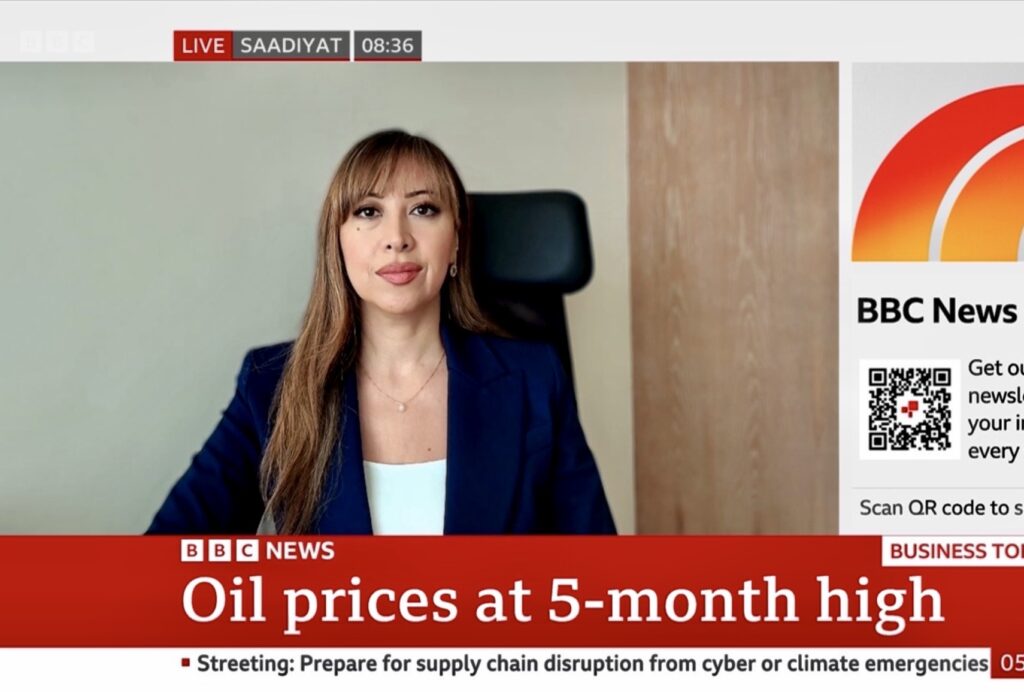



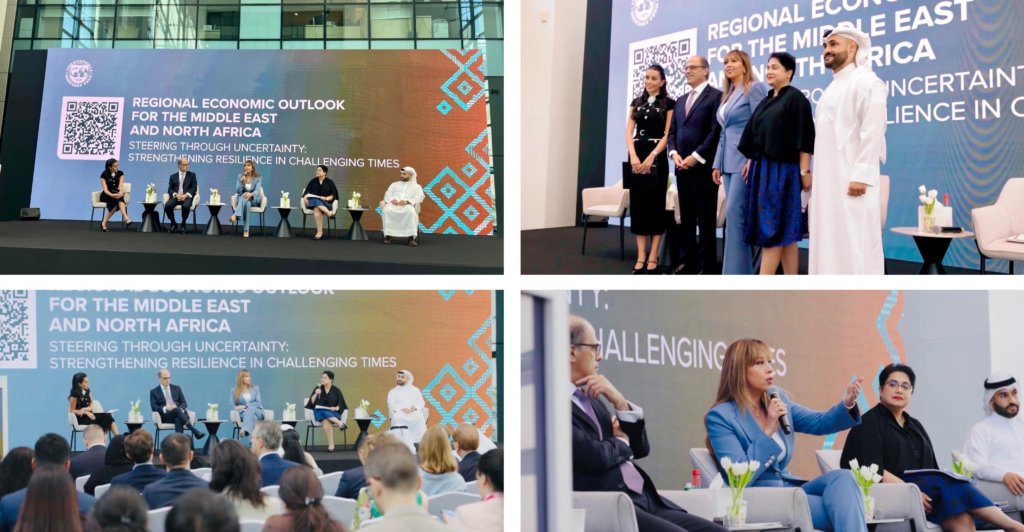
Crystol Energy CEO Dr. Carole Nakhle joined a high-level panel at the launch of the International Monetary Fund‘s (IMF) Regional Economic Outlook for the Middle East and North Africa, held in Dubai on 22 October 2026. The discussion examined the economic implications of the ongoing Middle East conflict, including its impact on energy markets and the region’s economic outlook.
Drawing on the unprecedented disruption to global energy supplies, Dr Nakhle highlighted the substantial economic costs behind market resilience, the importance of international cooperation and the need to rethink energy security from the perspective of producers as well as consumers.
Resilience is neither cheap nor built overnight
The scale and breadth of the disruption are unprecedented, affecting multiple countries and virtually every part of the energy supply chain, from production and refining to infrastructure, shipping and trade routes. Yet, despite the magnitude of the shock, energy prices have responded less dramatically than might have been expected.
Dr Nakhle emphasised that this resilience reflects decades of investment, diversification, persistent policy commitments and international cooperation. However, maintaining energy flows comes at a substantial economic cost, including longer and more expensive transport routes, higher freight and insurance costs, additional security measures and infrastructure damage.
“Oil prices tell us how markets are absorbing the shock. They do not tell us the full economic cost of the disruption,” Dr Nakhle noted.
These costs are unevenly distributed, with countries and businesses directly affected by the conflict bearing a disproportionate burden.
The geopolitical paradox of greater resilience
Dr Nakhle raised two concerns about the implications of this resilience.
First, the international cooperation and coordination that helped build it are increasingly under threat. Weakening these foundations could undermine the effectiveness of future responses to energy disruptions.
Second, greater market resilience may have an unintended geopolitical consequence. If global markets can absorb disruptions of historic proportions without an overwhelming economic shock, could this reduce the international economic pressure to bring conflicts to an end?
The risk is that prolonged disruption becomes more tolerable at the global level, even as the economic costs for affected countries continue to mount.
Energy security matters to producers, too
Dr Nakhle also called for a broader understanding of energy security, traditionally discussed from the perspective of consuming countries seeking diversified imports, reliable supplies and affordable prices.
For producers, the conflict has exposed a different vulnerability: possessing abundant resources offers limited protection when those resources cannot reach international markets reliably or economically.
This is particularly relevant to the Middle East, where competitiveness increasingly depends not only on the cost of extracting energy but also on the cost and security of delivering it to customers.
Dr Nakhle highlighted another longstanding weakness: despite possessing some of the world’s largest energy resources, the Middle East has relatively limited cross-border energy infrastructure connectivity. Greater regional integration, alternative export routes and stronger cooperation could help address vulnerabilities that individual countries cannot resolve alone.
Looking beyond the immediate crisis
Dr Nakhle concluded that the remarkable resilience of global energy markets should not obscure the economic damage experienced by countries directly affected by the conflict or the vulnerabilities that remain across energy infrastructure and trade networks.
Greater energy-market resilience does not eliminate economic costs or geopolitical risks. Sustaining it will require continued investment, stronger international and regional cooperation, and an approach to energy security that recognises the needs of producers as well as consumers.
The discussion brought together Dr Nakhle, Jihad Azour, Director of the IMF‘s Middle East and Central Asia Department; Monica Malik, Chief Economist at Abu Dhabi Commercial Bank (ADCB); and Hasan Alhasan, Senior Fellow for Middle East Policy at the International Institute for Strategic Studies (IISS). The panel was moderated by Abeer Abu Omar of Bloomberg.
Related Events
“Crystol Energy Delivers Keynote at IPIECA Week in London“, Apr 2026
“Carole Nakhle on Energy, Geopolitics, and Talent at Arab Women Business Forum, London“, Apr 2026
“Dr Carole Nakhle joins Energy Connects Global Advisory Board“, Jan 2026
“Crystol Energy leads strategic LNG discussions at the World LNG Summit in Istanbul“, Dec 2025