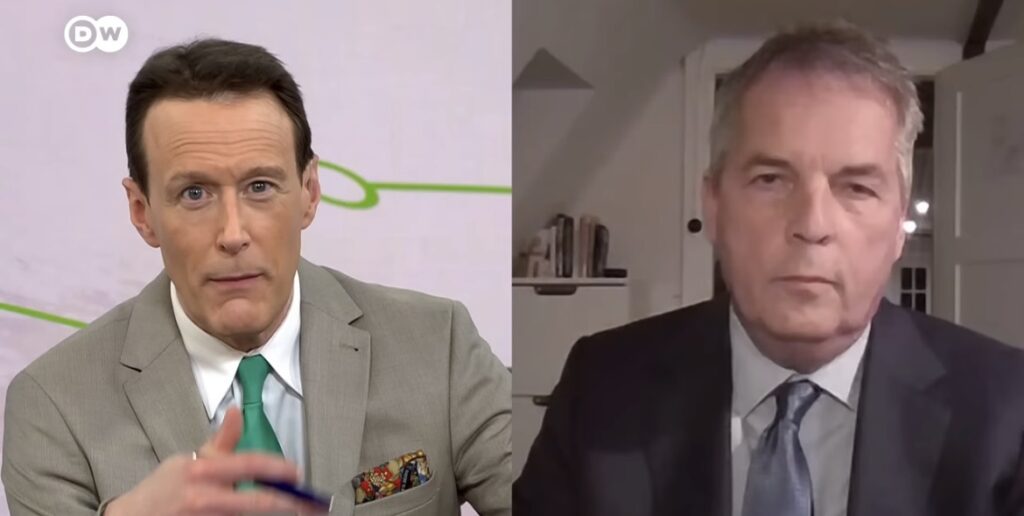



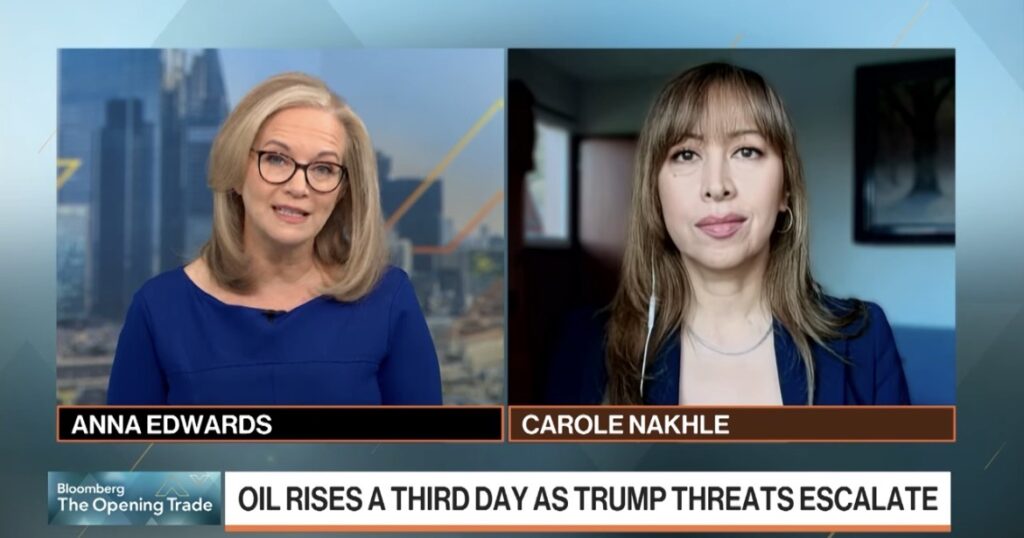
In an interview with Bloomberg’s Anna Edwards and Guy Johnson, Dr. Carole Nakhle, CEO of Crystol Energy, discussed how the latest Middle East tensions are affecting oil markets, tanker flows, and Europe’s energy outlook.
Key takeaways:
The biggest disruption in oil markets today is not a widespread loss of production capacity, but the difficulty of moving barrels smoothly through the Strait of Hormuz.
Some supplies are already being rerouted, including flows across Saudi Arabia to the Red Sea, which helps ease pressure and limits the risk of a prolonged supply shock.
The Strait of Hormuz should not be seen as fully closed, but rather as an area where passage is being controlled, creating uncertainty over which vessels can pass and under what conditions.
Even if a deal is reached soon, the region may continue to carry a risk premium if control over shipping remains a source of pressure on markets.
Oil prices are being shaped by uncertainty and volatility more than by a clear market direction, which makes short term futures signals difficult to interpret with confidence.
Physical market prices offer a more useful reading of current conditions than dramatic comparisons with past crises, which can exaggerate the scale of the present disruption.
Panic buying would make conditions worse by adding artificial upward pressure to prices at a time when markets are already strained.
Europe and Asia are responding differently, with Asia showing stronger demand management efforts, while Europe appears calmer and possibly better prepared after the 2022 energy shock.
For Europe, diesel and jet fuel look the most exposed, especially because Russian supplies that once played a major role are no longer available at previous levels.
Europe is unlikely to run out of fuel, but it may have to pay significantly more as competition for available barrels intensifies.
Related Analysis
“Crisis without collapse: The Middle East oil shock“, Dr Carole Nakhle, Apr 2026
Related Comments
“What measures could EU countries consider to reduce fuel demand?“, Christof Rühl, Apr 2026
“War puts key Iranian oil terminals at risk“, Dr Carole Nakhle, Mar 2026