



Recent geopolitical tensions in the Middle East have prompted comparisons with the 1973 oil crisis. However, according to Crystol Energy, the current situation differs fundamentally in both its underlying drivers and its market implications.
Commenting in a BBC article by Rachel Clun, Dr Carole Nakhle, CEO of Crystol Energy, highlighted that the 1973 oil shock was triggered by a deliberate embargo combined with coordinated production cuts, leading to a near quadrupling of oil prices and a global economic crisis marked by high inflation and recession.
“Today’s disruptions are of a different nature,” said Dr Nakhle. “They are driven by geopolitical risks and security concerns rather than a coordinated supply restriction. While the volumetric disruptions are significant, the market context has evolved considerably.”
Oil production, share of world
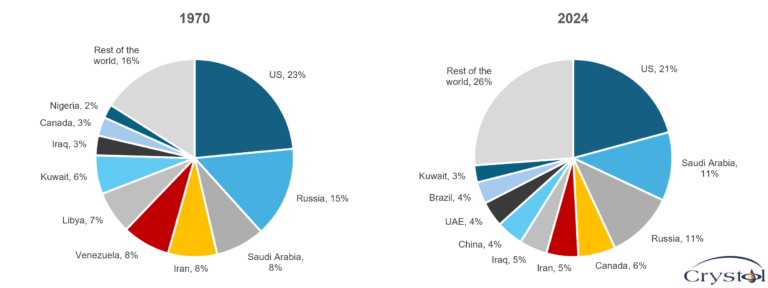
Since the 1970s, global oil markets have undergone profound structural changes. Oil’s share in global primary energy consumption has declined from nearly 50% to around 30%, while oil intensity has more than halved. At the same time, supply has become more diversified, with OPEC’s share of global production falling from around half to roughly one-third, and new sources of production emerging, including the United States as a net exporter.
Institutional developments have also strengthened market resilience. The creation of the International Energy Agency (IEA) and the establishment of Strategic Petroleum Reserves have provided mechanisms to mitigate supply shocks and enhance energy security.
“As a result, today’s oil market is more resilient, less oil-intensive, and better equipped to absorb disruptions,” Dr Nakhle added. “This helps explain why, despite the scale of current disruptions, oil prices – while elevated – are not commensurate with the severity of the crisis.”
Crystol Energy emphasises that while short-term volatility is likely to persist, the structural differences between the two periods are critical to understanding current market dynamics and price behaviour.
Related Comments
“The Saudi oil pipeline the world didn’t know it needed“, Dr Carole Nakhle, Mar 2026
“US eases sanctions on Russian oil amid energy crisis sparked by Iran conflict“, Christof Rühl, Mar 2026
“War puts key Iranian oil terminals at risk“, Dr Carole Nakhle, Mar 2026