




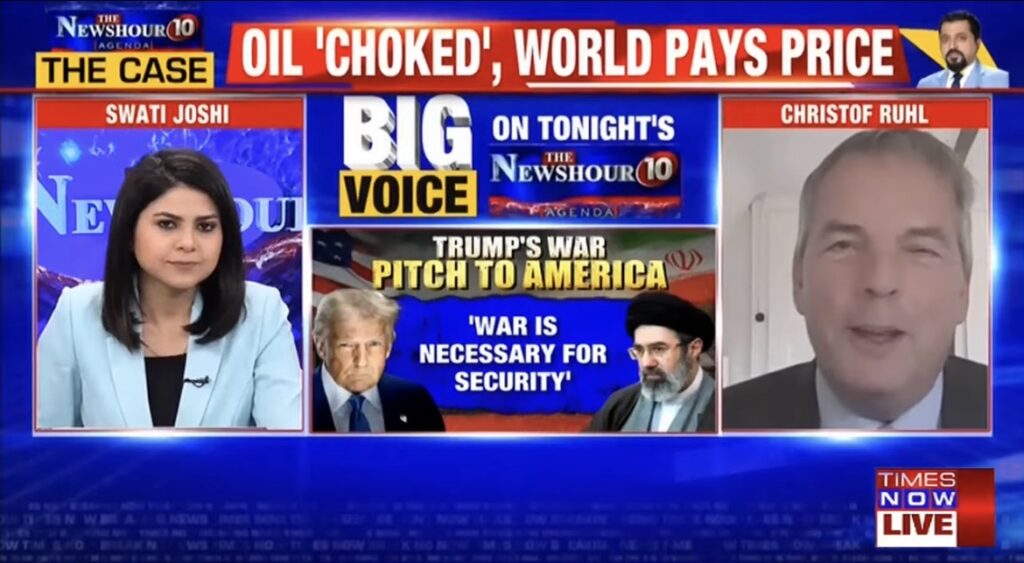
In an interview with Times Now, Christof Rühl, Global Advisor at Crystol Energy, shared his perspective on how the prolonged conflict involving Iran, Israel, and the United States is reshaping oil and gas market expectations. He explained that the outlook still depends on whether the disruption remains limited to shipping routes or expands into direct damage to production and export infrastructure. For now, he noted, global energy markets still have buffers, but those buffers are not unlimited.
Key takeaways:
The direction of oil and gas markets still depends on whether the conflict causes deeper physical damage to production facilities, transport infrastructure, or export routes.
If hostilities were to stop and the Strait of Hormuz reopened quickly, oil prices could ease fast because the market entered the crisis with excess supply and additional buffers.
The Strait of Hormuz remains one of the world’s most critical energy chokepoints, and any attempt to treat its disruption as a regional issue ignores the global nature of oil and gas markets.
Global oil markets still have several short term cushions, including strategic reserves, oil already at sea, and earlier oversupply, but these protections would weaken if disruption deepens or lasts longer.
In natural gas, the immediate shock is still manageable, but any further escalation could create more serious pressure given Qatar’s importance in global LNG trade.
A prolonged crisis would not only affect prices in the short term, but could also accelerate efforts to diversify supply routes and reduce dependence on major energy bottlenecks.
Related Comments
“US eases sanctions on Russian oil amid energy crisis sparked by Iran conflict“, Christof Rühl, Mar 2026
“War puts key Iranian oil terminals at risk“, Dr Carole Nakhle, Mar 2026