





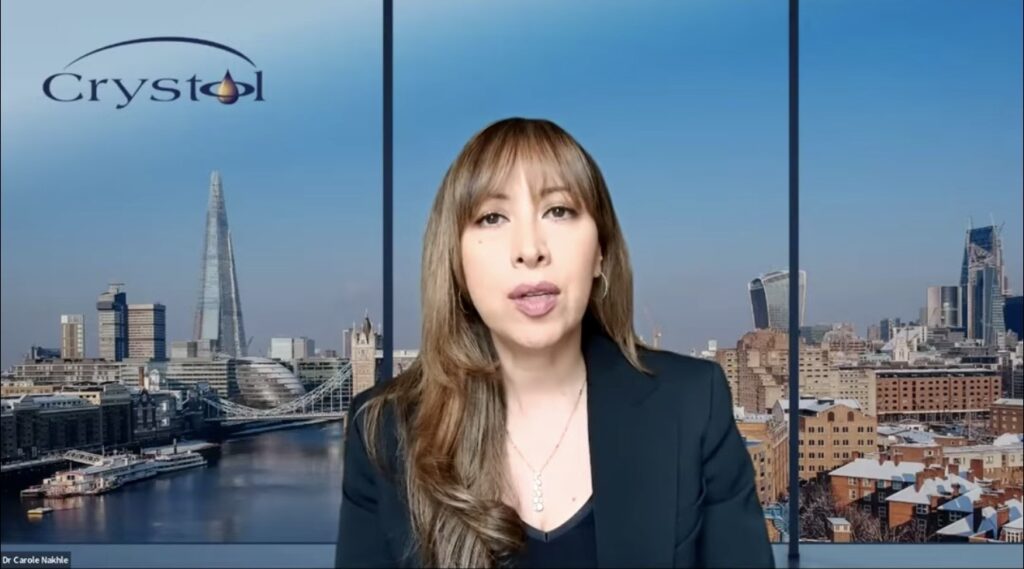
In a webinar hosted by Enzi Ijayo and the African Future Policies Hub, Dr. Carole Nakhle, CEO of Crystol Energy, explored how the Strait of Hormuz crisis is affecting global energy markets and what it means for African economies. She explained that while the disruption is extremely serious, markets have not yet moved into the worst case scenario. Her remarks focused on why energy prices have risen, why African economies face uneven exposure, and why diversification remains central to energy security.
Key takeaways:
The crisis is serious, but markets have not yet entered the most extreme scenario despite the scale of the disruption.
African economies will not all feel the shock in the same way, as importers face rising costs while some producers may benefit from higher prices.
Energy security comes from diversification across energy sources and supply partners, not from relying too heavily on one option.
Africa cannot quickly replace the Middle East in global energy markets, even though the continent holds significant long term potential.
This crisis should push governments to strengthen resilience, improve revenue management, and prepare better for future shocks.
Beyond Dr. Nakhle’s intervention, the webinar also examined fertilizer costs, food security, shipping and logistics disruptions, subsidy pressures, trade resilience, and the implications of repeated global shocks for Africa’s transition pathways.
The discussion also featured Ken Opalo, Associate Professor at Georgetown University, and Senior Advisor at AFPH; Ebipere Clark, Managing Partner at Frontier Alpha LLP; and Benjamin Boakye, Executive Director of the Africa Centre for Energy Policy.
Related Comments
“US eases sanctions on Russian oil amid energy crisis sparked by Iran conflictIran War: Asia most at risk in an LNG shortage“, Christof Rühl, Mar 2026
“War puts key Iranian oil terminals at risk“, Dr Carole Nakhle, Mar 2026